


Last Updated on 2 weeks ago by Hitakshi Parmar
You’ve heard that content is king. You’ve published blog posts, written service pages, and filled your site with keywords. But your pages are still sitting on page two, three, or worse. The problem is almost never the quantity of your content. It’s that the content isn’t optimized the way Google actually works in 2026.
On-page SEO is the most controllable ranking factor in your entire strategy. Every change happens on your own website, on your own schedule, independent of backlinks, domain age, or competitor activity. When done correctly, it produces faster ranking improvements than almost anything else in SEO.
This guide covers every on-page SEO factor that matters in 2026, in the order you should tackle them, with practical steps that work for businesses in both the USA and UK.
What Is On-Page SEO and Why Does It Still Matter in 2026?
On-page SEO is the practice of optimizing individual web pages so they rank higher in search engines and earn more relevant traffic. It includes everything you control directly on a page: content quality, title tags, meta descriptions, header structure, internal links, image optimization, schema markup, Core Web Vitals performance, and formatting for AI Overviews and answer engines.
In 2026, on-page SEO serves two audiences simultaneously. The first is the human being reading your content, who needs clarity, usefulness, and a reason to stay. The second is the machine deciding whether to rank or cite your page, which evaluates relevance, structure, authority signals, and technical quality.
Does traditional on-page SEO still make a difference? Unambiguously, yes. Google’s own documentation confirms that the most basic relevance signal is the presence of the same keywords as the user’s search query. If you search any competitive keyword, the pages ranking at the top almost universally use that exact keyword in their title tag. Keywords still matter. Structure still matters. The difference is that these signals now work alongside E-E-A-T, AI readiness, and behavioral engagement signals rather than in isolation.
Content quality and relevance account for roughly 40% of ranking influence in 2026. Getting on-page right is the single highest-leverage activity available to any website owner.
The Five Categories of On-Page SEO in 2026
Think of on-page SEO as five interconnected layers, each one building on the one below it:
- Content Foundation
- HTML Elements
- Linking and Internal Structure
- Technical On-Page Performance
- AI Search Optimization
Work through them in this order. Technical blockers left unresolved will undermine every content improvement you make above them.
Category 1: Content Foundation
Search Intent First, Keywords Second

The most common on-page SEO mistake in 2026 is optimizing a page for a keyword without asking what the person searching that keyword actually wants to find.
Search intent is the underlying goal behind a query. Google categorizes it broadly into four types: informational (the user wants to learn), navigational (the user wants to find a specific site), commercial (the user is researching before buying), and transactional (the user is ready to act now).
When your page’s content type mismatches the intent behind its target keyword, it will not rank. A product page targeting an informational keyword will not outrank a helpful guide. A guide targeting a transactional keyword will not outrank a product or service page. Match the format and depth of your content to what Google already shows at the top of results for that keyword. This is the fastest on-page fix available and the one most often ignored.
How to check intent: search your target keyword in an incognito browser and study what Google is already showing at the top. Are they blog posts or service pages? Long guides or quick answers? Your page needs to match that pattern before keyword placement, internal linking, or schema can help you.
Content Depth and Topical Coverage
Thin content, pages with fewer than 400 words that skim the surface of a topic, are a consistent ranking liability in 2026. Google’s quality systems are sophisticated enough to evaluate whether a page genuinely addresses the full range of a user’s likely questions about a topic.
This does not mean every page needs to be 3,000 words. It means every page needs to be as long as the topic requires to fully satisfy the reader’s intent. A local plumber’s service page does not need a 2,500-word essay. But it does need to cover: what the service includes, where it is available, what the process looks like, pricing context, and trust signals. That might be 600 words of genuinely useful content, and that is enough.
For informational content targeting awareness or consideration keywords, depth matters more. Analyze the top three to five ranking pages for your target keyword. What subtopics do they cover? What questions do they answer? Your content should cover all of those topics and at least one angle none of them address. This approach, often called the skyscraper technique, is still one of the most reliable content strategies in 2026.
E-E-A-T: The Trust Foundation That Cannot Be Faked

Experience, Expertise, Authoritativeness, and Trustworthiness. Google’s quality evaluators use E-E-A-T as a framework for assessing whether a page deserves to rank, particularly for topics that affect health, finances, safety, or major decisions.
The most important addition in recent years is the first E: Experience. Google now specifically rewards content written by people who have first-hand experience with the topic, not just theoretical knowledge. A review of a product written by someone who has actually used it carries more weight than a review written purely from research. A legal guide written by a practicing solicitor or attorney ranks better than the same guide written by a content agency with no legal background.
Practical E-E-A-T signals to build into every page:
- Author bylines with real names and credible bios, ideally linking to an author page with credentials
- First-person experience language where relevant: “In our work with clients,” “We tested,” “Based on our experience”
- Citations and references to authoritative external sources
- Clear publication dates and last-updated dates
- About page, contact page, and privacy policy that establish your business as real and reachable
- Real testimonials, case studies, or client results on service pages
For businesses in the USA and UK serving professional services sectors, law, finance, healthcare, or accountancy, E-E-A-T is not optional. It is the primary signal separating pages that rank from pages that do not.
Category 2: HTML Elements
Title Tags
Your title tag is the single most important on-page HTML element. It appears in search results, browser tabs, and social shares. Get it wrong and your page loses clicks even when it ranks.
Rules for title tags in 2026:
- Keep them under 60 characters to avoid truncation in search results
- Place your primary keyword as close to the beginning as possible
- Make the title compelling and specific, not just keyword-stuffed: “On-Page SEO Guide 2026: 19 Factors That Actually Move Rankings” outperforms “On-Page SEO 2026 | SEO Tips | SEO Guide“
- Every page must have a unique title tag. Export your entire site’s title tags via Screaming Frog and audit for duplicates immediately
Google does not always use your written title tag. Its systems may rewrite it if they judge your title as misleading or too different from the page’s content. The best defense against unwanted rewrites is writing accurate, descriptive, non-clickbait titles that genuinely reflect the page.
Meta Descriptions
Meta descriptions do not directly affect rankings. They directly affect click-through rate, which affects how much traffic a well-ranking page actually generates.
Write meta descriptions that:
- Stay between 150 and 155 characters
- Include the target keyword naturally (Google bolds matching keywords in snippets, which increases visual prominence)
- Communicate a specific value proposition: what will the reader gain from clicking?
- Sound like a human wrote them, not a keyword tool
A well-written meta description on a page ranking at position four can outperform position two competitors with weak descriptions. Treat it as ad copy, not an SEO checkbox.
Header Structure (H1, H2, H3)
Your heading hierarchy helps both readers and search engines navigate the structure of your content. The rules are simple but regularly broken:
- One H1 per page, containing the primary keyword, used as the page title
- H2s for major sections of the content
- H3s for subsections within H2s
- Never use headings for visual styling. Use CSS for that. Headings are navigational structure, not decoration
Headers are one of the first things AI engines use to understand what a page covers. In 2026, writing descriptive, specific H2 headings that match common search questions dramatically increases the probability of appearing in featured snippets, People Also Ask boxes, and AI Overview citations.
URL Structure
Clean URLs are a lightweight but real ranking signal and a significant user experience factor.
Best practices:
- Keep URLs short, lowercase, and descriptive: /on-page-seo-guide-2026/ not /p?id=4291&cat=3&type=blog
- Use hyphens to separate words, not underscores
- Include the primary keyword naturally, but do not force it. A URL does not need to be an exact keyword match to rank
- Avoid changing URLs on established pages. A URL change without a proper 301 redirect loses all ranking history and link equity
Category 3: Linking and Internal Structure
Internal Linking Done Right
Internal links serve two functions simultaneously. They help users navigate to related content, and they distribute ranking authority (PageRank) from strong pages to weaker ones.
Most websites drastically underuse internal linking. New pages are published and linked to from a navigation menu or a related posts widget, but never from the body of the most relevant existing content.
Build internal links deliberately:
- When you publish a new page, identify five to ten existing pages on your site that mention the same topic and add contextual body-copy links from those pages to your new page
- Vary your anchor text naturally. Not every internal link to your local SEO service page needs to say “local SEO services.” Mix in “our local optimization work,” “how we approach local search,” and branded variations
- Pages with the most organic traffic and external backlinks are your most powerful internal link sources. Prioritize getting links from these pages to your most important service and product pages
Orphan Pages
An orphan page has no internal links pointing to it from the rest of your site. Search engines may find it via your sitemap, but it will receive almost no crawl attention and virtually no internal link equity. Run a regular crawl using Screaming Frog to identify orphan pages and add relevant internal links to them.
Category 4: Technical On-Page Performance
Core Web Vitals
Core Web Vitals are confirmed Google ranking factors. In 2026, the targets are:
- Largest Contentful Paint (LCP): under 2.5 seconds
- Interaction to Next Paint (INP): under 200 milliseconds
- Cumulative Layout Shift (CLS): under 0.1
Poor Core Web Vitals scores actively suppress rankings for pages competing with similar content quality and link authority. Run your pages through Google’s PageSpeed Insights regularly. Fix the specific issues it identifies, whether that is image compression, render-blocking JavaScript, or unspecified image dimensions causing layout shift.
Image Optimization
Images are one of the biggest sources of page slowness and one of the most consistently overlooked on-page SEO elements:
- Use WebP or AVIF format rather than JPEG or PNG for most images
- Compress every image before upload. A 2MB hero image is an avoidable performance penalty
- Write descriptive alt text for every image. This supports both accessibility and image search rankings
- Use lazy loading for images below the fold
- Specify image width and height attributes in HTML to prevent layout shift during page load
Mobile Optimization
Google uses mobile-first indexing. Your mobile experience is the version Google evaluates for ranking purposes, regardless of whether most of your visitors use desktop. Check every key page in Google Search Console’s Mobile Usability report and fix flagged issues without exception.
Category 5: AI Search Optimization (New for 2026)
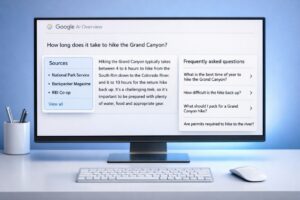
This is the layer that separates 2026 on-page SEO from every previous year’s approach.
AI Overviews are now appearing in a significant percentage of Google searches, particularly for informational and commercial queries. When AI pulls content into an Overview, the source pages receive citation visibility that is arguably more valuable than a standard organic ranking. Users associate cited brands with authority.
Formatting for AI Synthesis
AI engines do not read pages the way humans do. They scan for clear structural signals: a direct answer early in the content, organized sections with descriptive headings, bullet points that summarize complex information, and definitions that answer the query immediately.
Practical AI formatting techniques:
- Answer first: Lead each section with a direct answer to the question the section addresses, then provide supporting detail. This mirrors the inverted pyramid style used in journalism and is exactly what AI engines look for
- Definition blocks: For any term central to your content, include a clear one-to-two sentence definition early in the page. These are highly cited in AI Overviews
- Structured FAQs: A FAQ section at the bottom of every informational page dramatically increases your probability of being cited for question-based queries
- Numbered steps: For how-to content, use numbered lists rather than prose paragraphs. AI engines extract these cleanly and cite them in step-by-step answer formats
Schema Markup for On-Page AI Visibility
FAQ schema, HowTo schema, and Article schema are the three highest-impact schema types for on-page AI visibility. Implement them using JSON-LD format in the page head. Validate your schema using Google’s Rich Results Test after every implementation.
Pages with schema markup achieve 20 to 40% higher click-through rates than equivalent pages without it. For informational content competing to appear in AI Overviews, FAQ schema is not optional. It is a baseline.
On-Page SEO Audit: What to Check First
If you are auditing an existing page rather than building a new one, work through this priority order:
Priority 1: Search intent match. Is the page format (guide, product page, comparison, etc.) aligned with what Google is already ranking for this keyword? If not, the page needs a structural overhaul before any other optimization will help.
Priority 2: Title tag and meta description. Are they unique, under character limits, keyword-inclusive, and compelling? These are the fastest fixes with the fastest click-through impact.
Priority 3: E-E-A-T signals. Does the page demonstrate real expertise and experience? Is there a named author? Are claims supported by references or evidence?
Priority 4: Content depth and topical coverage. Does the page fully address the user’s likely questions? Are there obvious subtopics covered by competing pages that yours ignores?
Priority 5: Internal linking. Are there opportunities to add contextual links from high-traffic pages to this one? Does this page link out to relevant supporting content?
Priority 6: Technical performance. Does the page pass Core Web Vitals? Are images optimized? Is the mobile experience clean?
Priority 7: AI formatting and schema. Is there a FAQ section? Are answers provided directly at the top of relevant sections? Is applicable schema markup implemented?
Common On-Page SEO Mistakes That Are Costing You Rankings
Keyword stuffing: Repeating your target keyword unnaturally throughout the content does not improve rankings. It triggers quality filters and makes your content worse for readers. Use the keyword naturally once or twice in prominent positions and rely on semantic variations and related terms throughout.
Targeting the wrong intent: A page cannot rank for a keyword if its content type mismatches the intent behind that keyword. This is the single most common reason a well-written, well-linked page stagnates at position 12.
Ignoring the meta description: It does not affect rankings directly, but a weak meta description reduces click-through rate significantly. Lower CTR can indirectly impact rankings over time as Google interprets it as a signal that your page is not the most satisfying result.
Duplicate title tags: Multiple pages with identical or near-identical title tags tell Google you have not differentiated your content. Audit for duplicates quarterly.
Publishing without internal links: Every new page should receive at least three to five internal links from relevant existing content on the day it is published.
No schema markup: In 2026, pages without FAQ or structured data schema are at a consistent disadvantage for both featured snippet eligibility and AI Overview citation.
Conclusion: On-Page SEO Is the Fastest Path to Better Rankings
Link building takes months. Domain authority builds over years. On-page SEO changes can impact rankings within days of Google re-crawling your page.
For businesses in the USA and UK investing in SEO, on-page optimization is the highest-ROI activity available. It costs nothing but time, it is entirely within your control, and improvements compound: a better title tag earns more clicks, which sends stronger behavioral signals to Google, which sustains and improves your ranking.
Start with your ten most important pages. Check intent match first, then title tags, then E-E-A-T signals, then content depth. Fix one page fully before moving to the next. You will see results faster than you expect.
FAQs
Q1. What is the most important on-page SEO factor in 2026?
Search intent match is the most critical factor. No amount of keyword optimization, schema markup, or internal linking will make a page rank if its content type does not align with what users searching that keyword actually want to find.
Q2. How often should I update my on-page SEO?
Revisit your highest-traffic and highest-priority pages at least quarterly. Check for: changes in competing pages that have taken ranking positions, new keywords your page ranks for that could be better optimized, and opportunities to add AI-friendly formatting like FAQ sections or definition blocks.
Q3. Does keyword density still matter in 2026?
No fixed keyword density metric matters. Using a keyword unnaturally multiple times in every paragraph actively harms both readability and rankings. Use your primary keyword in the title, H1, and naturally in the first paragraph. After that, focus on covering the topic comprehensively with related terminology rather than repeating the exact phrase.
Q4. Should I optimize for AI Overviews specifically?
Yes. AI Overviews are appearing across a significant and growing percentage of Google searches. Formatting content with direct answers, FAQ sections, and clear structured headings dramatically increases your probability of being cited. This is the single most important new dimension of on-page SEO in 2026.
Q5. How long should my pages be for good on-page SEO?
Length should match the topic’s requirements, not a word count target. Informational blog posts often benefit from 1,500 to 3,000 words when covering complex topics. Service pages rarely need more than 600 to 800 words of genuinely useful content. The right length is whatever fully satisfies the reader’s intent without padding.

