

Last Updated on 2 weeks ago by Hitakshi Parmar
Your online store has products. A checkout. Competitive prices and genuine reviews. But if your product pages are invisible when buyers search you are losing revenue every single day to competitors who have mastered ecommerce SEO.
Here is the scale of the opportunity you are sitting on right now:
- 43% of all ecommerce traffic globally comes from organic Google search the single largest traffic source for online retail
- 70% of digital marketers confirm SEO drives more sales than PPC at a fraction of the long-term cost
- 96.55% of all indexed pages receive zero organic traffic — because they were never properly optimized
- 86% of ecommerce brands have poor internal linking, costing them thousands of ranking positions every month
Unlike paid ads, which vanish the moment your budget stops SEO builds a compounding revenue asset that keeps delivering traffic and qualified buyers month after month, year after year.
This guide covers the complete ecommerce SEO strategy for 2026, built specifically for online stores in the USA and UK that are serious about driving sustainable organic revenue. Written by Senior SEO Strategist at AllUnique SEO Agency, with hands-on experience optimizing ecommerce stores across fashion, home improvement, health, and B2B product verticals.
Expert Insight:
In 15+ years of ecommerce SEO, the single biggest mistake I see online stores make is treating their category pages like navigation menus. Category pages ARE your primary revenue-driving SEO assets. The stores that treat them as landing pages with content, schema, and internal links consistently outrank larger competitors with bigger budgets.
Why Ecommerce SEO Is Harder Than Regular SEO And Why That Creates Your Advantage
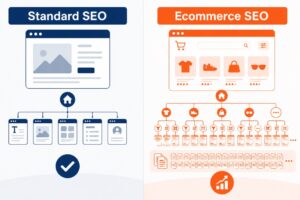
Our ecommerce SEO services are built around one central reality: ecommerce SEO is uniquely complex. You are not optimizing one page or ten. You are managing hundreds — sometimes thousands — of product URLs, category pages, filter combinations, pagination systems, and seasonal content simultaneously, all while competing with Amazon, eBay, and well-funded large-scale retailers.
But here is the advantage most stores never discover: the big players are structurally weak in specific, high-value areas.
- Amazon dominates branded and generic searches — but loses to niche authority on long-tail, product-specific queries
- Large retailers cannot build deep topical content for every micro-niche — but you can
- Local stock availability, specialist expertise, and niche buying guides are areas where independent stores win every time
| What Large Retailers Do Well | Where Independent Stores Win |
| Branded keyword dominance | Long-tail, hyper-specific product queries |
| Budget for broad paid campaigns | Deep topical authority in your niche |
| Product volume and range | Specialist expertise content (buying guides) |
| Generic category rankings | Local availability + faster delivery claims |
| Mass-market brand recognition | Community trust + authentic reviews |
Step 1: Keyword Research Built for Ecommerce Buyers: The 2026 Method
Ecommerce keyword research starts from a fundamentally different place than informational SEO. You are not looking for topics to explain. You are looking for the exact phrases buyers type at four distinct stages of the purchase journey.
The Four Ecommerce Keyword Types You Must Map
| Keyword Type | Intent Signal | Best Page Target |
| Transactional | Buy, order, cheap, best price, free shipping | Product pages, category pages |
| Commercial Investigation | Best [product], vs, review, worth it | Buying guides, comparison posts |
| Informational | How to choose, what is, difference between | Blog posts, FAQ pages |
| Navigational | Brand name searches | Homepage, brand pages |
| ⚠️ USA vs UK Keyword Alert
US and UK ecommerce buyers use different terminology for many products. ‘Trainers’ vs ‘sneakers’. ‘Jumpers’ vs ‘sweaters’. ‘Biscuits’ vs ‘cookies’. ‘Car boot’ vs ‘car trunk’. Always create separate keyword research for each market and use hreflang tags to serve the correct version. UK stores should also optimise for Bing — it holds a higher UK market share than in the USA. |
How to Build Your Ecommerce Keyword Matrix (Step-by-Step)
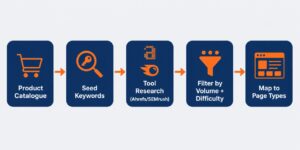
- Start with your product catalogue list every product category you sell
- For each category, identify the primary commercial keyword (e.g., ‘men’s running shoes’)
- Generate 3–5 long-tail variants using Ahrefs, SEMrush, or Google Keyword Planner filtered to USA or UK separately
- Identify informational keywords for blog content to support each category
- Score each keyword by: Search Volume + Keyword Difficulty + Commercial Value (CPC as a proxy)
- Map keywords to specific page types never target the same keyword on two different pages
For deeper guidance on keyword strategy, read our complete guide on keyword research for SEO which covers competitor gap analysis, semantic clustering, and tool-by-tool workflow.
Step 2: Site Architecture That Search Engines Can Crawl, Understand, and Rank
Site structure is the foundation beneath everything else in ecommerce SEO. It determines how efficiently Google crawls your store, how ranking authority flows between pages, and how clearly you signal topical relevance.
The Ideal Ecommerce Site Architecture
Think in clean silos: Home → Category → Subcategory → Product. Every product should be reachable within 3 clicks from the homepage. Pages buried deeper than 3 clicks receive dramatically less crawl attention and significantly less internal link equity from Google.
- Homepage: Broad domain authority hub — links to all category pages
- Category page (e.g., Power Tools): Targets high-volume, broad commercial keywords
- Subcategory page (e.g., Cordless Drills): Targets more specific commercial terms
- Product pages: Captures exact-match, high-intent transactional queries
Common Architecture Mistake
Flat architecture where all products link directly from the homepage or a single-level sitemap is one of the most common ecommerce SEO mistakes. It dilutes authority, makes crawling inefficient, and prevents your category pages from building the topical relevance they need to rank.
Handling Faceted Navigation — The Biggest Technical Trap
Faceted navigation (product filters for size, colour, price, and brand) is one of the two biggest technical SEO traps in ecommerce. Each filter combination generates a unique URL, potentially creating thousands of thin, near-duplicate pages that dilute crawl budget and trigger content duplication issues.
| Problem | Correct Solution |
| Filter URLs creating duplicate content | Use canonical tags pointing to parent category |
| Thousands of thin filter pages | Use noindex on low-value filter combinations |
| URL parameters wasting crawl budget | JavaScript-based filtering (no new URL generated) |
| Color/size variants as separate pages | Canonical all variants to primary product page |
| Genuine filter search demand | Build these as intentional optimised subcategory pages |
For a deeper technical review of your site architecture, explore our technical SEO services we audit crawlability, index coverage, and faceted navigation issues for ecommerce stores of all sizes.
Step 3: Category Page Optimisation: Your Most Valuable SEO Asset
Category pages are the most strategically important pages in any ecommerce store. They target broad, high-volume commercial keywords and funnel ranking authority down to every product page within them. Yet most stores treat category pages as product grids with a title and nothing else leaving enormous ranking opportunity on the table.
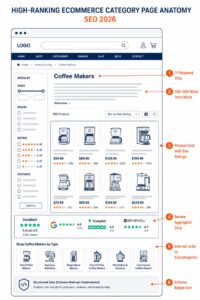
What a High-Ranking Category Page Includes in 2026
- Keyword-optimised H1: ‘Men’s Running Shoes’ — specific, clean, keyword-aligned
- Introductory content block (150–300 words): Naturally includes primary keyword, 2–3 related terms, and answers ‘Why buy this category from us?’
- User-generated content integration: Reviews aggregated at category level add fresh, keyword-rich content automatically
- Internal links to subcategories and buying guides: Creates content cluster structure distributing authority efficiently
- Schema markup: AggregateOffer or ItemList schema triggers rich results in Google Shopping and standard search
Read our complete on-page SEO guide for the full technical breakdown of optimising every element of a commercial landing page including category pages.
Step 4: Product Page SEO That Converts Browsers into Buyers
Product pages must do two things simultaneously: rank in search and convert visitors into buyers. These goals are more aligned than they appear — the signals Google uses to evaluate product page quality (engagement time, low bounce rate, structured content, genuine reviews) are largely the same signals that indicate a strong buying experience.
Product Title Optimisation
Your product title (H1) must include: the primary keyword for that product, differentiating details (brand, model, key specification), and natural language — not a keyword string.
| ❌ Poor Product Title | ✅ Optimised Product Title |
| cordless drill 18v makita brushless | Makita 18V Cordless Drill — Brushless Motor, 3-Year Warranty |
| women shoes red | Women’s Red Running Shoes — Lightweight, Cushioned, Size 3–9 |
| laptop bag | 15-Inch Laptop Backpack — Waterproof, USB Charging Port, Business Travel |
Product Descriptions That Rank AND Convert
Generic manufacturer descriptions are a duplicate content problem. If ten other retailers use the same description, Google has no reason to prefer your version. Write original product descriptions that:
- Lead with the primary benefit to the buyer — not the technical specification
- Include the primary keyword naturally in the first 50 words
- Cover specifications in structured format: bullet points or HTML table
- Answer pre-purchase questions: Best for who? What’s included? What size/compatibility?
- Use the language of your market: British English for UK, American English for USA — including idiom and tone
| 📈 Revenue Impact of Reviews
Pages with customer reviews rank measurably better than those without. Shoppers are 270% more likely to purchase a product with 5+ reviews than one with zero. Implement Product schema with AggregateRating to display star ratings in search results — pages with this markup achieve 20–40% higher click-through rates. Rich results drive 82% higher CTR compared to standard snippets. For UK stores, Trustpilot integration adds recognised consumer trust signals. |
Step 5: Technical SEO for Ecommerce — The 2026 Requirements
Page Speed and Core Web Vitals
Speed is a critical conversion and ranking factor in ecommerce. Every additional second of page load time reduces conversions measurably. The 2026 Core Web Vitals targets are harder to meet for ecommerce sites than for simple content sites — because of large product images, complex JavaScript, and third-party integrations.
| Core Web Vital | 2026 Target | Ecommerce Risk Factor |
| LCP (Largest Contentful Paint) | Under 2.5 seconds | Large product hero images |
| INP (Interaction to Next Paint) | Under 200ms | Heavy JavaScript / filter interactions |
| CLS (Cumulative Layout Shift) | Under 0.1 | Images without set dimensions |
Priority speed fixes for ecommerce stores in 2026:
- Compress and convert all product images to WebP format
- Implement lazy loading for product images below the fold
- Defer non-critical JavaScript — payment processors, chat widgets, analytics pixels
- Use a CDN to serve assets faster to both USA and UK users (critical for cross-market stores)
- Minimise third-party scripts: every external pixel and analytics tag adds measurable load time
Crawl Budget Management
- Submit an updated XML sitemap whenever new products are added
- Use noindex on thin pages: empty category pages, wishlist pages, cart pages, search result pages
- Implement canonical tags on product variant pages (12 colour variants → canonical to primary product page, unless each colour has separate search demand)
- Fix broken internal links that waste crawl budget on dead ends
If your store has more than 500 product pages, consider a professional technical SEO audit to identify crawl budget leaks, indexation issues, and canonical conflicts before they cost you rankings.
Step 6: Ecommerce Link Building: Authority Without Begging for Links
Ecommerce product and category pages rarely attract editorial links naturally. The most effective 2026 strategy: build authority through content that earns links, then use internal linking to transfer that authority to your commercial pages.
The Four Link-Earning Strategies That Work for Ecommerce
- Buying guide content: Comprehensive category guides attract links from review sites, bloggers, and industry publications those links boost domain authority, which lifts your product pages
- Original research: UK ecommerce statistics, consumer trend data, or price index reports earn links from industry publications and national media
- Digital PR: Pitching newsworthy brand stories — seasonal pricing trends, unusual product launches, consumer surveys — earns editorial links from publications that would never link to a product page directly
- Supplier and manufacturer links: If you are an authorised retailer, ask manufacturers whether they maintain a retailer directory with links; many do, and these carry strong relevance authority
Our off-page SEO services combine digital PR, guest posting, and authority link acquisition specifically designed for ecommerce stores targeting competitive USA and UK markets.
Step 7: Ecommerce Content Marketing: The Organic Authority Multiplier
The ecommerce stores that dominate organic search in competitive markets are almost universally those that invest in content beyond product descriptions and category pages.
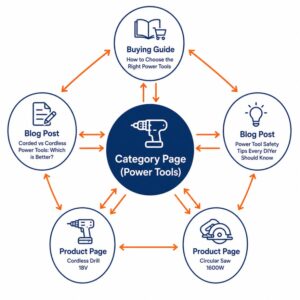
Buying Guide Strategy — One Guide Per Major Product Category
One comprehensive buying guide per major product category is the minimum content investment for competitive ecommerce SEO. A well-written buying guide for a competitive product category can drive more qualified traffic than dozens of average product pages — and earns backlinks that lift your entire category.
Seasonal Content Calendar — USA and UK
| USA Shopping Calendar | UK Shopping Calendar |
| Black Friday (November) | Black Friday (November — now equal to USA) |
| Cyber Monday | Boxing Day Sales (26 December) |
| Christmas (December) | January Sales |
| Memorial Day (May) | Valentine’s Day (February) |
| Fourth of July | Mother’s Day (UK: March) |
| Back to School (August) | Father’s Day (UK: June) |
| Amazon Prime Day (July) | Easter Weekend |
| ⏰ Publish Seasonal Content 6 Weeks Early
SEO takes time to build ranking authority. A buying guide published the week before Christmas will not rank in time to capture that traffic. Publish major seasonal content at minimum 6 weeks before peak demand — 8 weeks for highly competitive terms. |
Learn how we’ve helped ecommerce stores build sustainable content authority in our guide to how ecommerce SEO services help businesses sell, and explore our full ecommerce SEO services page for information on how we manage this for clients.
Step 8: Optimising for AI Search and Google AI Overviews in 2026
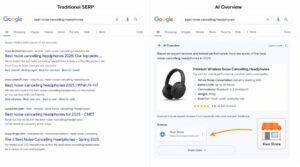
2026 marks the year AI Overviews and zero-click search become unavoidable for ecommerce SEO strategy. Many high-volume queries now generate AI-synthesised answers without sending users to your site. Here is how to stay visible:
- Add a clear, concise 2–3 sentence answer to your primary question within the first 100 words of every page
- Structure all step-by-step processes as numbered lists AI tools prefer clearly structured content
- Build Product, Offer, and Review schema so AI systems surface your products as trusted entities
- Track AI search visibility with tools like Semrush Brand Visibility Index or custom Google Search Console log analysis
- Target long-tail, specific modifiers that AI is less likely to summarise generically (e.g., ‘copper water bottle dishwasher safe BPA-free’)
- Ensure consistent brand signals across your site AI systems use entity recognition to decide which products to highlight
Explore our complete guide on how to optimise for AI rankings and discover what answer engine optimisation means for ecommerce stores specifically including our AEO checklist for technical and content.
Measuring Ecommerce SEO Performance: The Metrics That Matter
Track these metrics monthly to understand the business impact of your ecommerce SEO investment:
| Metric | Tool | Target / Benchmark |
| Organic revenue | Google Analytics 4 (GA4) | Month-over-month growth |
| Organic traffic by page type | GA4 + GSC | Product pages trending up |
| Keyword rankings (top 20 commercial) | Ahrefs / SEMrush | Track weekly |
| Product page conversion (organic) | GA4 | Industry avg: 1.5–3% |
| Crawl coverage / indexation | Google Search Console | New products indexed within 72hrs |
| Core Web Vitals (LCP, INP, CLS) | PageSpeed Insights / GSC | All green, all pages |
| AI Overview visibility | Semrush BVI / GSC | Track mention rate |
| 📅 Realistic SEO Timeline for Ecommerce
Long-tail product keywords: Initial ranking improvements in 6–12 weeks. Competitive category page rankings: 4–6 months of consistent optimisation and link building. Significant organic revenue growth: measurable within 6–12 months for well-optimised stores. Positive ROI typically achieved at the 6–12 month mark, accelerating strongly between months 6 and 18 as authority compounds. |
Ready to Build Your Ecommerce SEO Strategy?
| Get Your Free Ecommerce SEO Audit
We review your category pages, product page optimisation, site structure, and AI search readiness — then give you a prioritised action plan at no cost. |
Explore More from AllUnique SEO Agency
Related resources you may find valuable:
- Guide: Choosing the Right Ecommerce SEO Agency
- Strategy: CRO and SEO — How to Turn Rankings into Revenue
- Guide: On-Page SEO Guide to Ranking Higher
- Service: Ecommerce SEO Services
- Service: On-Page SEO Services
- Service: Technical SEO Services
- Tool Guide: AI Rank Tracking Tool for Google AI Overviews
FAQs: Ecommerce SEO Strategy 2026
Q1. What is the most effective ecommerce SEO strategy for 2026?
The most effective ecommerce SEO strategy in 2026 combines three pillars: category page optimisation (your primary commercial revenue driver), technical SEO (site architecture, Core Web Vitals, crawl budget management), and AI search readiness (FAQ schema, structured content, entity signals). Stores that treat category pages as full landing pages with content, schema, and proper internal linking consistently outrank larger competitors.
Q2. How long does ecommerce SEO take to show results?
Long-tail product keywords can show initial ranking improvements within 6–12 weeks of optimisation. Competitive category page rankings typically require 4–6 months of consistent work. Significant, measurable organic revenue growth is usually visible within 6–12 months for stores that implement the strategy correctly. The compounding nature of SEO means returns accelerate strongly between months 6 and 18.
Q3. Should I prioritise product pages or category pages first?
Category pages first, always. They rank for broader, higher-volume commercial keywords and funnel authority down to every product page within them. A single well-optimised category page can lift the rankings of dozens of product pages simultaneously through internal link equity transfer.
Q4. How do I compete with Amazon for product keywords?
Focus on long-tail and ultra-specific queries where Amazon’s generalist approach leaves gaps. Build genuine topical authority through buying guides and comparison content. Earn reviews and trust signals that make your store credible. Use niche differentiation — UK-specific terminology, faster delivery claims, or deep category expertise that Amazon cannot replicate. Local signals and community trust are two areas Amazon structurally cannot compete in.
Q5. Do I need separate SEO strategies for USA and UK?
Yes, always. Beyond hreflang implementation, keyword research differs significantly between markets — both in search volume and product terminology. The competitive landscape differs too. UK stores should additionally prioritise Bing optimisation, which holds stronger UK market share than in the USA. Content tone, spelling, and phrase choice should reflect each market’s audience.
Q6. Is ecommerce SEO worth the investment for small online stores?
Absolutely. Small stores can outrank larger competitors for niche, long-tail product queries because they can build deeper topical authority in a specific niche. A small UK outdoor equipment store can outrank large department stores for specific gear queries by building more genuinely useful buying guides and earning authentic reviews. The ROI of ecommerce SEO compounds over time unlike paid advertising, which stops the moment you stop spending.
Q7. What is the role of AI search in ecommerce SEO in 2026?
Google AI Overviews are now a primary result format for many product and buying intent queries. Ecommerce stores must optimise for both traditional organic rankings and AI Overview citation simultaneously. This means adding FAQ schema, writing clear structured answers within page content, maintaining consistent entity signals, and tracking AI visibility separately from traditional rank positions.

