

Last Updated on 53 seconds ago by Hitakshi Parmar
You’ve invested months into your B2B SEO strategy. Blog posts are live, backlinks are building, and Google Analytics shows a steady climb in organic traffic. But your CRM tells a different story: the pipeline is flat, MQL volume hasn’t budged, and your sales team is unimpressed.
Sound familiar? You’re not alone. The vast majority of B2B companies are optimizing for the wrong metric: traffic. And traffic, as any revenue-focused marketer knows, doesn’t pay salaries.
This guide breaks down how to redesign your B2B SEO strategy from the ground up with MQL generation as the north star, not pageviews.
Why Most B2B SEO Strategies Fail to Generate MQLs
The root problem is simple: most SEO strategies are built around what’s easy to rank for, not what converts. Teams chase high-volume keywords, publish educational blog content, and celebrate ranking on page one, without ever asking whether the people landing on those pages are actually buyers.
Here’s the disconnect. A post ranking for “what is a CRM” might bring in 5,000 monthly visitors, mostly students, salespeople at companies of two, and competitors doing market research. Meanwhile, a post targeting “CRM migration checklist for enterprise teams” might pull 200 visitors a month, but 15 of them are IT directors at mid-market companies actively evaluating software. Only one of those posts is doing real work for your pipeline.
The other major failure mode is neglecting the bottom of the funnel entirely. Most B2B SEO programs over-index on TOFU (top-of-funnel) content because it ranks faster and drives volume. BOFU content, the kind that targets people who are ready to buy, is harder to rank for and slower to build, so it gets deprioritized. This is exactly backwards if your goal is MQL generation.
The fix is a shift in philosophy: from traffic-first SEO to intent-based SEO for B2B.
Step 1: Rebuild Your Keyword Strategy Around Buyer Intent
Not all keywords are created equal, and in B2B, the gap between a high-volume informational keyword and a low-volume transactional one is measured in pipeline dollars.
B2B keyword intent mapping means categorizing every keyword you’re targeting or considering targeting by where it sits in the buyer journey. There are three buckets that matter:
- Awareness keywords target people who have a problem but haven’t defined it yet. Think “Why are my sales cycles so long?” or “enterprise software implementation challenges.” These bring volume but low conversion intent. They’re worth investing in for topical authority, not for direct MQL generation.
- Consideration keywords target active researchers comparing approaches. “Intent-based SEO for B2B“, “how to generate MQLs from organic search,” and “bottom of funnel SEO strategy” these people know what they want and are figuring out how to get there. Strong MQL potential with the right content and CTA.
- Decision keywords target buyers who are ready to act. “[your category] software for [specific use case],” “[competitor] alternative,” “[your category] pricing,” and “[your category] implementation checklist.” Low volume, very high intent. These are your MQL-generating pages, and they deserve your best content and most aggressive optimization.
A practical starting point: pull your last 12 months of organic traffic data. For each page that drives sessions, ask honestly, what intent does this keyword serve? If more than 60% of your traffic is coming from awareness-stage keywords, you have a conversion problem baked into your keyword strategy.
Step 2: Build a Full-Funnel Content Architecture
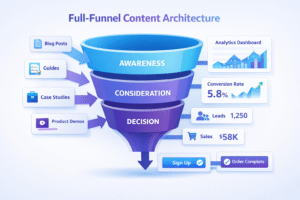
Keyword intent tells you what to write about. Content architecture tells you how to structure it so that each piece serves a pipeline purpose, not just a traffic goal.
The most effective B2B SEO content architecture is built around topic clusters. A pillar page covers a broad topic comprehensively and targets a high-authority head keyword. Supporting cluster content digs into specific subtopics—and critically, each cluster piece should map to a specific stage of the buyer journey.
Here’s what this looks like in practice for, say, a B2B HR software company:
- Pillar page: “Complete Guide to HR Software for Midmarket Companies” (broad, awareness-stage anchor)
- TOFU clusters: “What is HRIS?”, “HR tech stack explained,” “How to reduce employee turnover” (educational, builds topical authority)
- MOFU clusters: “HR software comparison: enterprise vs midmarket,” “How to build a business case for HR tech,” and “HR software implementation timeline” (consideration-stage, problem-aware buyer)
- BOFU clusters: “Best HR software for 200-500 employees,” “[Competitor] vs [Your Product] comparison,” “HR software pricing guide 2026” (decision-stage, high-intent buyer)
The BOFU pieces are where MQLs come from. They take longer to rank, but a single page ranking in position one for “best HR software for midmarket” can be worth more pipeline than fifty TOFU articles combined. That’s not hyperbole it’s a pattern you’ll find in virtually every high-performing B2B SEO program.
One critical note on BOFU content: it must be genuinely useful, not a thinly veiled sales pitch. Buyers at this stage have done their research. If your “best HR software” comparison page lists your product first and buries the trade-offs, you’ll lose credibility and the click. Be honest about who your product is and isn’t right for. That transparency builds trust and actually increases conversion rates.
Step 3: Optimise for Conversion, Not Just Rankings
Here’s the uncomfortable truth: you can rank page one for a high-intent keyword and still generate zero MQLs if your page isn’t designed to convert.
Most B2B content pages are optimized for SEO signals, keyword density, internal links, and meta descriptions but neglect the conversion layer entirely. The result is pages that rank well and bounce fast, with visitors leaving having absorbed your content but taken no action.
Match your CTA to the content’s intent stage
This is the most important conversion principle in B2B content marketing. A TOFU page explaining what a CRM does should not have a “Book a Demo” CTA that’s asking for a marriage proposal on a first date. Instead, offer something that matches where the reader is: a relevant guide, a comparison checklist, or an email course.
MOFU pages can push harder: an ROI calculator, a template download, or a webinar registration. BOFU pages are where the demo CTA belongs, alongside pricing information and a clear articulation of who the product is best suited for.
Use content upgrades to capture MQLs earlier
A content upgrade is a piece of downloadable content that’s directly relevant to the blog post a visitor is reading. If they’re reading your “HR software implementation timeline” article, a downloadable implementation project template is a natural, frictionless exchange of value for contact details. Done well, content upgrades can 5-10x the lead conversion rate of a standard newsletter pop-up.
Don’t neglect technical conversion signals
Page speed, mobile experience, and form friction all directly affect MQL conversion rates. A page that loads in 4 seconds loses a significant portion of its audience before they’ve read a word. Forms with more than five fields will see dramatically higher abandonment. These aren’t SEO issues per se, but they sit squarely in the SEO-to-MQL conversion chain.
Step 4: Build SEO Pipeline Attribution – Properly
If you can’t measure organic search’s contribution to the pipeline, you can’t optimize it, and you won’t be able to justify investment in it. SEO pipeline attribution is one of the most underinvested capabilities in B2B marketing, and it’s the primary reason SEO remains a secondhand channel in many organizations.
At a minimum, you need to track which organic landing pages are generating form fills, which of those form fills are being qualified as MQLs, and what revenue is ultimately attributed to those MQLs. Most CRMs—Salesforce, HubSpot, and others, can capture UTM data and first/last-touch attribution natively. The gap is usually in inconsistent UTM hygiene and in connecting organic traffic sources to closed-won revenue.
Multi-touch attribution models are more accurate than first- or last-touch for B2B, given the length of sales cycles. A buyer might discover your brand via an organic blog post, come back two weeks later through a Google ad, then convert on a direct visit. Last-touch attribution credits the direct visit and makes your SEO program look worthless. A W-shaped or linear attribution model tells a more honest story.
Beyond attribution, build a regular reporting cadence around organic MQL metrics, not organic traffic. Present to leadership on MQLs sourced from organic, pipeline influenced by organic content, and organic SEO ROI. This reframes SEO as a revenue channel and tends to unlock significantly more investment.
Step 5: Align SEO with the Full GTM Motion
B2B SEO doesn’t generate MQLs in isolation; it works best when it’s integrated with the rest of your go-to-market motion. This means coordinating with sales, product marketing, and demand generation, not operating as a separate channel with its own agenda.
Sales teams are an underused source of SEO intelligence. They hear the same objections, questions, and comparisons from prospects every day, and those are all keyword opportunities. A regular monthly sync between SEO and sales to capture what questions are coming up most often in discovery calls can produce more useful content briefs than any keyword tool.
Product marketing knows your competitive positioning better than anyone. That positioning should inform your BOFU content competitor comparison pages, use-case landing pages, and ROI calculators. These are high-intent pages that will generate MQLs, but they require a level of product knowledge that pure SEO content teams rarely have. The integration between SEO and product marketing is where the highest-converting B2B content gets made.
Paid and SEO should also be running in parallel, not in separate budget silos. High-intent keywords that you’re investing in organically are often worth testing with paid search simultaneously; the combined visibility increases click-through rates and accelerates the pipeline contribution of that keyword cluster. Once organic rankings are established, you can pull back paid spend; until then, there’s no reason to leave that intent unserved.
A Note on AI Search and What It Means for B2B MQL Generation

In 2026, it would be incomplete to discuss B2B SEO strategy without addressing AI-powered search. Tools like ChatGPT, Perplexity, and Google’s AI Overviews are increasingly the first stop for B2B buyers doing research, not a Google search results page.
This changes the distribution equation meaningfully. Content that gets cited in AI-generated answers, whether in ChatGPT responses or Google’s AI Overviews, drives brand awareness and intent even without a click. B2B buyers are forming opinions about vendors before they ever visit a company’s website, based on what AI tools say about them.
The implication for MQL-focused SEO is that E-E-A-T (Experience, Expertise, Authoritativeness, Trustworthiness) matters more than ever, not just as a Google ranking signal, but as a criterion for being cited by AI systems. Well-researched content, original data, clear expert authorship, and authoritative external citations all increase the probability of your content appearing in AI-generated answers. Content that gets surfaced in those answers builds brand trust with buyers who are still three or four touchpoints away from an MQL, and that trust pays dividends when they eventually reach your site.
Putting It All Together: The MQL-First SEO Framework
B2B SEO that generates MQLs is not fundamentally different from standard SEO in its mechanics, technical foundation, quality content, and strong links. What makes it different is the strategy layer: every decision is made through the lens of buyer intent, pipeline attribution, and sales alignment.
The framework in summary:
- Rebuild keyword strategy around intent stages, not volume; prioritize BOFU and MOFU over TOFU.
- Design a full-funnel content architecture using topic clusters that map to awareness, consideration, and decision stages.
- Optimize every page for conversion, matching CTAs to intent stage and using content upgrades to capture MQLs earlier.
- Build SEO pipeline attribution using multi-touch models and report on MQLs and revenue, not traffic.
- Integrate SEO with sales, product marketing, and paid to ensure content reflects real buyer questions and competitive reality.
Traffic is vanity. MQLs are sanity. The B2B companies winning with SEO in 2026 are the ones that made the mindset shift from ranking for its own sake to building a content engine that reliably delivers qualified pipeline.
Start with intent. Build for buyers. Measure what matters.
Frequently Ask Questions:
Q1: What is the difference between B2B SEO for traffic and B2B SEO for MQL generation?
Traffic-focused SEO prioritizes ranking for high-volume keywords regardless of buyer intent, which often attracts students, researchers, and competitors rather than actual buyers. MQL-focused SEO starts with intent: targeting keywords that signal a real purchasing need, structuring content around the buyer journey, and optimizing every page for conversion rather than just rankings.
Q2: How long does it take for a B2B SEO strategy to start generating MQLs?
It depends on your domain authority, competitive landscape, and how much BOFU content you already have. Realistically, expect 3-6 months before bottom-of-funnel content starts ranking meaningfully, and 6-12 months before you see a consistent MQL contribution from organic search.
Q3: Which content types generate the most MQLs from organic search?
Bottom-of-funnel content consistently outperforms on MQL conversion: competitor comparison pages, category-specific buyer guides (e.g., “best [software] for [industry]”), pricing pages, ROI calculators, and implementation checklists. These attract low-volume but high-intent traffic from buyers who are actively evaluating solutions, making them far more valuable per visit than broad educational content.
Q4: How do you measure whether your SEO program is generating MQLs?
Start by ensuring your CRM captures the original organic landing page for every lead. From there, track which pages are generating form fills, what percentage of those leads are qualifying as MQLs, and what pipeline and revenue are ultimately attributed to organically sourced leads. Use a multi-touch attribution model rather than last-touch, as B2B buyers typically interact with multiple touchpoints before converting.
Q5: Should B2B companies prioritize SEO or paid search for MQL generation?
Both serve different roles and work best together. Paid search delivers immediate visibility for high-intent keywords while your organic rankings build. SEO compounds over time; a page ranking organically generates MQLs at near-zero marginal cost per lead, which paid search never achieves.
